






Business impact Banks & Financial Institutions
Apply the same intelligence foundation to the decisions and workflows that matter most to this segment.

e-Invoicing compliance Timeline

UAE e-Invoicing: The Complete Guide to Compliance and Future Readiness

Types of Vendor Verification and When to Use Them

Safeguard Your Business with Vendor Validation before Onboarding

Modernizing Dealer/Distributor & Customer Onboarding with BridgeFlow

Accelerate Vendor Onboarding with BridgeFlow

GST Filing 360°: GST, E-Invoicing, E-Way Bills & Annual Returns Made Simple

Why Manual Tax Determination Fails for High-Volume, Multi-Country Transactions
GST Filing 360°: GST, E-Invoicing, E-Way Bills & Annual Returns Made Simple

Key Features of an Invoice Management System Every Business Should Know

Automating the Shipping Bill & Bill of Entry Invoice Operations for a Leading Construction Company

From Manual to Massive: How Enterprises Are Automating Invoice Signing at Scale

AI-Powered Voice Assistant for Smarter Search Experiences

Cygnet.One’s GenAI Ideation Workshop

Our Journey to CMMI Level 5 Appraisal for Development and Service Model

Extend your team with vetted talent for cloud, data, and product work

Enterprise Application Testing Services: What to Expect

Future-Proof Your Enterprise with AI-First Quality Engineering

Cloud Modernization Enabled HDFC to Cut Storage Costs & Recovery Time

Cloud-Native Scalability & Release Agility for a Leading AMC

AWS workload optimization & cost management for sustainable growth

Cloud Cost Optimization Strategies for 2026: Best Practices to Follow
Cygnet.One’s GenAI Ideation Workshop

Practical Approaches to Migration with AWS: A Cygnet.One Guide
Tax Governance Frameworks for Enterprises

Cygnet Launches TaxAssurance: A Step Towards Certainty in Tax Management

10 Generative AI Use Cases Driving Enterprise Value

Navigating the Generative AI Landscape

Truly Rise with SAP: The Business Integrators Guide

Mastering SAP S/4HANA Migration: Essential Pre-Migration Strategies and Preparation
Convert scanned or digital bank statements, Account Aggregator JSON and banking feeds into consolidated cash-flow intelligence. Identify income, obligations, spend patterns, bounces, related-party flows, anomalies and document risks across multiple accounts.
 within the Cygnet Finalyze experience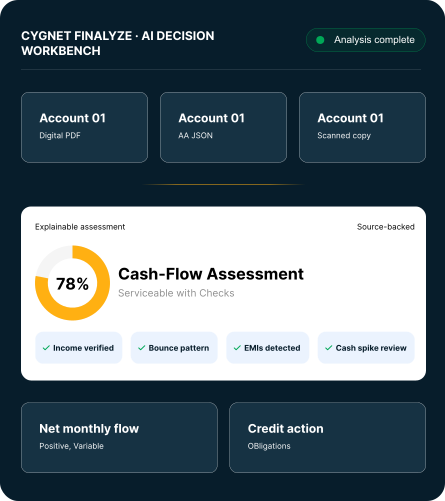
Accept digital PDFs, scans, passbooks, images, AA JSON, or direct banking feeds.
Read account details, balances, and every transaction using OCR, layout understanding, and validation.
Categorize income, spends, EMIs, transfers, bounces, cash activity, and other financial behavior.
Consolidate accounts, identify duplicates and related flows, and prioritize anomalies or risk indicators.
Generate configurable Excel, JSON, or XML outputs for credit assessment and downstream decisioning.
Processes physical and digital statements while checking format, sufficiency, vintage and possible tampering indicators.
Understands transaction context to identify income, obligations, expenses, bounces, cash flow and behavior.
Converts findings into product-specific reports, risk signals and reviewer actions for lending workflows.
Reduction in processing time cited on the current Cygnet bank statement analysis page.
Published Cygnet customer outcome for a finance company’s loan-processing journey.
Automated extraction and analytics reduce repetitive manual review for standard cases.
Use one intelligence foundation across lending, risk monitoring and counterparty assessment, with the workflow and controls required by each segment.
Apply the same intelligence foundation to the decisions and workflows that matter most to this segment.
Apply the same intelligence foundation to the decisions and workflows that matter most to this segment.
Apply the same intelligence foundation to the decisions and workflows that matter most to this segment.
Analysts can validate and override low-confidence or high-risk classifications.
Set required vintage, sufficiency, account ownership and product rules.
Support encryption, masking and configurable retention or purging requirements.
Show the transactions and patterns behind each material risk indicator.
Retain input, extraction, categorization, review and output history.
ntegrate through APIs and align deployment to enterprise security requirements.
It can process digital and scanned bank statements, passbooks, smartphone images, e-PDFs, AA JSON and supported direct banking feeds.
It goes beyond extraction to provide multi-account analysis, income verification, spend categorization, obligation detection, cash-flow metrics, bounces, anomaly signals and configurable reports.
Yes. Related accounts can be combined into a consolidated view while inter-account transfers and duplicate flows are identified to avoid overstating income or turnover.
GLIB.ai provides the document and transaction intelligence used to process bank statements. Cygnet Finalyze connects those insights with broader credit, GST, ITR and risk workflows.
Yes. API-led integration can return structured data and reports to LOS, LMS, core banking, CRM or custom underwriting systems.
Low-confidence classifications, missing periods, anomalous transactions and policy-sensitive signals can be routed to analysts for review and override.
Cygnet Finalyze is an AI-first credit decisioning platform for banks, NBFCs and corporates, unifying GST, bank, financial statement, ITR and invoice intelligence.
Automate financial spreading with agentic AI. Extract balance sheets, P&L, cash flows and notes into ratios, scorecards, risk insights and credit memos.
Analyze GST sales, purchases, tax payments, customer and vendor concentration with AI-led business intelligence for cash-flow lending and risk monitoring.
Automate ITR analysis for income verification, profitability ratios, repayment assessment and lending risk using authorized data, AI-OCR and API integration.