



































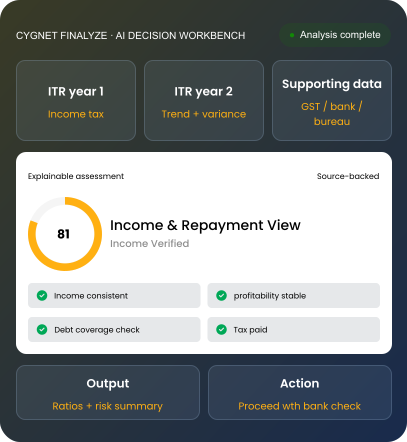
Why change Challenges this solution is built to solve
ITR filings are central to assessing declared income and business profitability, but forms differ by taxpayer type and year. Manual extraction and ratio computation slow underwriting and make consistency difficult.
Complex return structures
Individuals, proprietors, firms and companies file different forms with varied schedules and disclosures.
Manual income extraction
Analysts must identify income sources, liabilities, taxes and business performance across pages.
Ratio and trend rework
Debt, profitability and coverage ratios are repeatedly calculated in spreadsheets.
Declared data may not align
ITR income and profitability should be compared with GST, bank and other borrower evidence.
How it works From raw data to a governed business decision
Cygnet Finalyze creates a governed ITR analysis flow from authorized data intake or uploaded documents to ratio-based, cross-validated credit insight.
Collect authorized data

Use supported portal journeys or upload digital or scanned ITR documents.
Validate and classify

Identify taxpayer, return type, assessment year, completeness and document quality.
Extract financial data

Capture income, business results, liabilities, taxes, deductions and relevant schedules.
Calculate and compare

Generate ratios, multi-year trends and discrepancy signals against supporting data.
Publish credit output

Send structured data, findings and review status to appraisal or monitoring workflows.
AI-first architecture Intelligence that understands, evaluates and acts
AI is used where it creates measurable value: structuring data, identifying context, detecting risk, explaining findings and routing exceptions, while keeping people and policy in control.
Layer 01 ITR Data Understanding
Interprets return forms and schedules to structure income, tax, liabilities and business information.
- Return classification
- Schedule extraction
- AI-OCR input
Layer 02 Financial Assessment
Calculates profitability, leverage, coverage and multi-year trend indicators.
- Debt/equity
- Debt/EBITDA
- Interest coverage
- Profit ratios
Layer 03 Cross-Validation & Action
Compares declared information with bank, GST or other evidence and routes material differences for review.
- Variance flags
- Risk summary
- API output
Business impact Designed for BFSI, NBFCs and corporates
Use one intelligence foundation across lending, risk monitoring and counterparty assessment, with the workflow and controls required by each segment.
Business Impact
Banks & Financial Institutions
Apply the same intelligence foundation to the decisions and workflows that matter most to this segment.
Where It Helps
Priority use cases
- Verify income for retail, professional and business lending
- Standardize multi-year ITR assessment
- Support secured, MSME and corporate appraisal
- Cross-check declared income with other data sources
Operating Model
What changes for teams
- Fewer manual preparation steps
- Consistent evidence and risk logic
- Exception-led analyst review
- Structured integration into existing systems
Business Impact
NBFCs & Digital Lenders
Apply the same intelligence foundation to the decisions and workflows that matter most to this segment.
Where It Helps
Priority use cases
- Accelerate document-led applications
- Reduce spreadsheet ratio calculations
- Use API outputs in digital underwriting
- Route only material variances for analyst review
Operating Model
What changes for teams
- Fewer manual preparation steps
- Consistent evidence and risk logic
- Exception-led analyst review
- Structured integration into existing systems
Business Impact
Corporates & Large Enterprises
Apply the same intelligence foundation to the decisions and workflows that matter most to this segment.
Where It Helps
Priority use cases
- Assess proprietors and business counterparties
- Support distributor or dealer credit evaluation
- Add tax-return evidence to vendor/customer reviews
- Compare declared performance with GST-led operating data
Operating Model
What changes for teams
- Fewer manual preparation steps
- Consistent evidence and risk logic
- Exception-led analyst review
- Structured integration into existing systems
Why Cygnet Finalyze Move beyond disconnected data tools
The differentiator is not AI as a label. It is verified data, specialized document intelligence, explainable risk logic and integration into the decisions your teams already make.

Traditional approach
- Manual reading of return forms and schedules
- Repeated ratio calculations in Excel
- Single-year view without trend context
- Limited cross-check against other evidence
- Unstructured analyst notes
AI-native Cygnet approach
- Automated form and schedule understanding
- Consistent ratios and multi-year trends
- Cross-source discrepancy prioritization
- Structured outputs and analyst-ready summaries
- API integration with human review controls
Governed AI Enterprise control around every AI-assisted output
Support faster decisions without turning models into a black box. Review, override, trace and integrate outputs within your own governance model.
Authorized Data Use
Use appropriate authorization and consent for tax-return data access.
Human Validation
Route low-confidence fields and material discrepancies to reviewers.
Source Traceability
Retain links between extracted values and the underlying return or schedule.
Configurable Ratios
Apply institution-specific formulas, thresholds and policy checks.
Decision Trail
Capture extraction, review, override and final output history.
Secure Integration
Transfer only required structured outputs into downstream systems.
- Income tax data journey
- LOS / LMS
- Bank statement analysis
- GST Business Intelligence
- Credit bureau
- Document portal
- Data warehouse
- REST APIs
Frequently asked questions Questions credit, risk and technology teams ask
It structures declared income, business profitability, liabilities, tax information and relevant schedules, then calculates ratios and trends for credit assessment.
Yes. It can support relevant return types for salaried individuals, professionals, proprietors and business entities, subject to configured scope and available data.
Examples include debt-to-equity, debt-to-EBITDA, interest coverage, gross profit, net profit and other configured profitability or leverage ratios.
Yes. Cygnet Finalyze can compare declared income or business performance with GST activity, bank cash flow and other borrower evidence to prioritize discrepancies.
Yes. Uploaded digital or scanned documents can be processed through AI-OCR and intelligent document processing when structured data is unavailable.
Yes. Extracted fields, ratios, trends, risk flags and review status can be sent to LOS, LMS or custom systems through APIs.